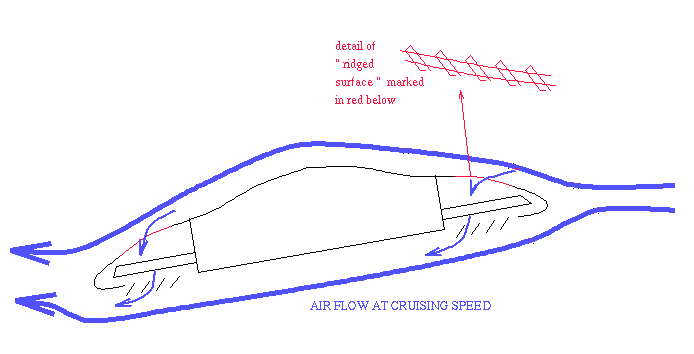
The very first design was inspired by the problems with the Avrocar. In the first place, I worried about the the high cost of the three jet engines that the Canadians used and so considered a design with a conventional combustion engine and propeller. What kept the Avrocar from ever really taking off (it only hovered a few feet from the ground) was that it was too instable despite having advanced electronic controls to compensate this.
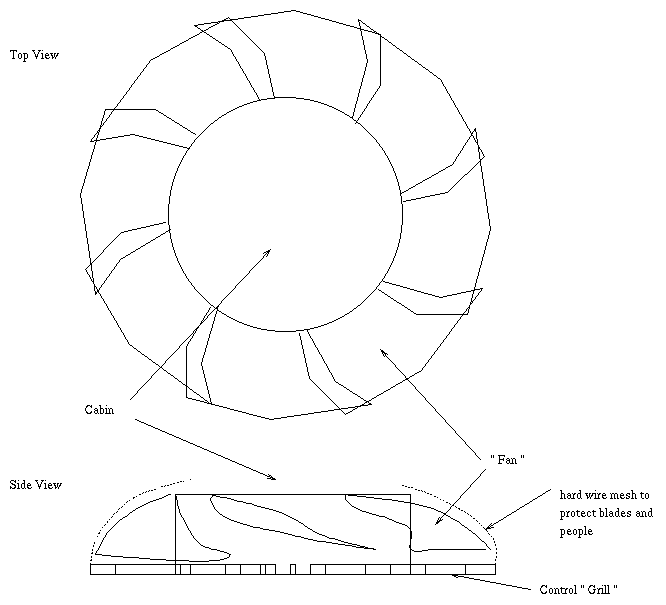
The above picture shows a strange propeller with wide blades that spin around a central hole, where the main aircraft (cabin) is. This spinning mass should have a gyroscopic effect, giving a lot of stability (at the cost of making maneuvers more complicated). Under the blades there are a set of deflection vanes - what I have called the "control grill". These vanes change angle as a unit, like venecian blinds. Actually, there are four separate groups in order to allow the craft to go forward, back, turn around, tilt up and down and so on. The spinning fan would tend to make the cabin spin in the opposite direction, but the control grill can be adjusted to compensate for this.
Over the propeller is a wire protection to avoid people stepping on the blades (specially if they are turning!) or dropping objects. This wire mesh has no aerodynamical function. The novel idea, here, is that the blades have such a shape that when the propeller is turning very fast, it forms a "virtual airfoil". As the aircraft moves forward, the air would flow over the propeller creating additional lift without requiring additional power from the engine, reducing fuel consumption at cruise speeds. If this sounds a bit silly, you are probably noticing my electronic engineering background. We EEs are used to making things go so fast that they act as if they were standing still in a controlled way (switched capacitors, pulse width modulation and so on). Since one of our major worries is that the forward moving blades shouldn't exceed the speed of sound, we can be sure that the propeller won't be fast enough to become a "virtual airfoil".
Here is a small change to try to fix these problems. The propeller still has the middle part missing, but the blades are now much more conventional. The wire mesh has been replaced with a grid that allows air to flow easily down when hovering, but deflects most of it around the aircraft when moving forward.
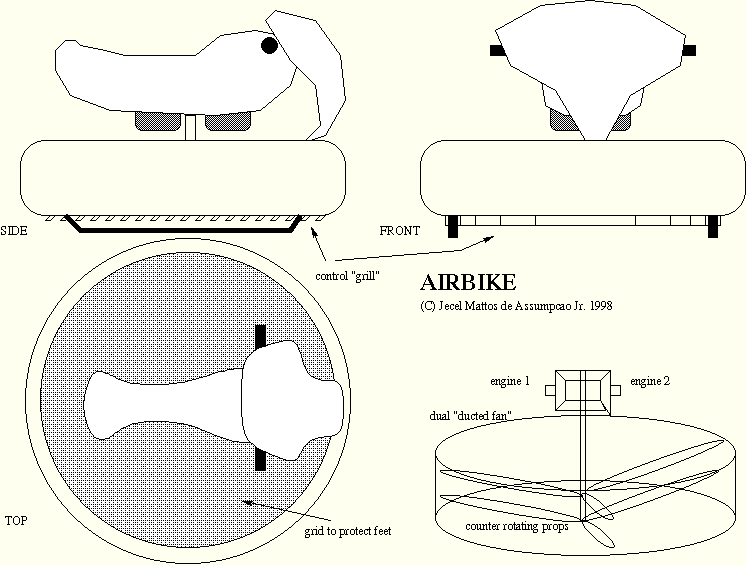
A very similar design is the Airbike. This drawing didn't turn out very well, but at least it gives a good idea of how it works. This one is derived from the Hiller Flying Platform. The main problem with that machine was that in order to be stable, the pilot had to struggle against it to keep it leaning forward in order to get anywhere. This was very tiring (it also failed in terms of marketing - the military decided it didn't want a sniper platform which would leave the shooter totally exposed!).
Here the pilot gets to sit down, and a control grill from the previous designs is used instead of leaning to move the craft forward and back. In order to take turns you still have to lean sideways, but that is true for conventional motorcycles as well. The wire grid to protect the feet was also borrowed from the other designs. Two engines are used to drive both propellers, so that an engine failure is not catastrophic. Though it is not easy to see in the drawing, the two propellers have the blades at a steep angle relative to horizontal (they form a cone instead of a disk when turning) and that is what keep the craft from turning over. Electronic protection system would keep the operator from running out of fuel in mid air, coming down too fast and so on.

In the previous design, the two propellers turn in opposite directions which requires one drive shaft to fit inside the other. Keeping the ends of these shafts from vibrating is very hard. And though I don't have a drawing, the overall design of the airbike had changed significantly and it was no longer practical to have the engines in the center (the redesign was meant to optimize the aircraft for forward movement instead of hover, with the result somewhat like a cross between a jetski and a sting ray). This drawing show an alternative way of driving the two propellers: a ring is attached to their edge which fits tightly against three rollers inside the large duct. The engine's shaft goes down right outside the duct and has gears going through a hole in the duct to contact each propeller's ring. The whole idea is to avoid having obstacles to the airflow in the middle of the duct.
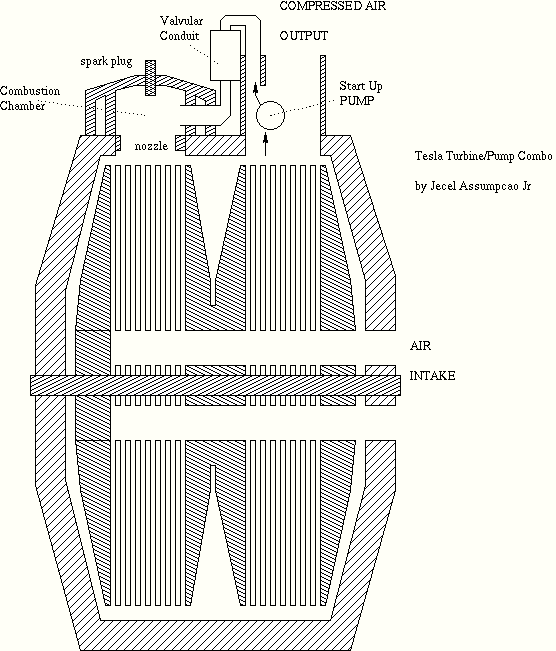
The drawing shows a Tesla Turbine on the left on the same shaft as the Tesla Pump on the right. The pump draws air from the intake and outputs most of it at the output to generate thrust. A small part of the compressed air is diverted into the combustion chamber in order to drive the turbine. The exhaust from the turbine flow back into the pump in order to be mixed with the incoming fresh air. This reduced the heat and pollution generated by this jet engine.
A small pump is needed to compress air for the combustion chamber when the engine is being started.

In the first design, the turbine and the pump were the same size. Here the pump was split in two - one to compress air for the combustion chamber and another to generate a vacuum for the turbine output and to accelerate the air to generate thrust. The heavy middle disks (for separation) from the first design were eliminated since I decided that the leak between the pump and turbine would not be a problem. It is important to note that this "cut" doesn't show how both the output and the path from pump1 to the combustion chamber form spirals around the case of the engine.

Here is a simple application using the Tesla Combo as a jet engine. Obviously inspired by the Rocket Belt, this design was meant to be usable for more than 20 seconds at a time. There are other efforts to achieve this using propellers, but I now feel that jets are much more efficient if they can be made simple and cheap enough. Here the eight small jets are placed in a convenient position relative to the pilot's center of gravity so that most of the maneuvers can be easily accomplished simply by moving his legs. The back pack itself is simple the fuel tank, hopefully enough for 15 minutes to over half an hour of flight.

Another application uses the ideas from the first few designs - to convert the aircraft from a powered lift one to an airfoil based one at high speeds. This design has the advantage of being able to cruise on the ground like a regular car. The jet engines shown in the drawing are the valveless pulsejets developed at the University of Houston, but other engines can be used as long as they are cheap enough. One such engine design, the Dual Vortex Jet, evolved from the Tesla Combos by removing the single moving part of that design. This will be described here in more detail in the future.

This is a "jet delimited air cushion" type of hovercraft, but it isn't a very efficient one since in hover mode the two cushions are at a small angle relative to the ground and so leak. When accelerating one of the cushions (the left one in the drawing) leaks far more but since it then has to support a much smaller fraction of the pilot's weight there is no problem.
An interesting property of the hoverboard is that it tends to move towards the pilot's center of gravity rather than away from it as on a skateboard, so it is easier to keep from falling off. But the cushions are otherwise unstable, so if the pilot does jump or fall off then the board will flip over and stop instead of going on by itself into traffic or people.
The construction of the cushion generators is interesting in itself. Thin aluminum disks are stamped as shown, then the tabs are folded which separates the disk (a task normally done by star shaped washers in Tesla Pumps) and then a set of them are bolted on a flat electric motor. The lack of a central axis allows more air to be drawn in by the device.